
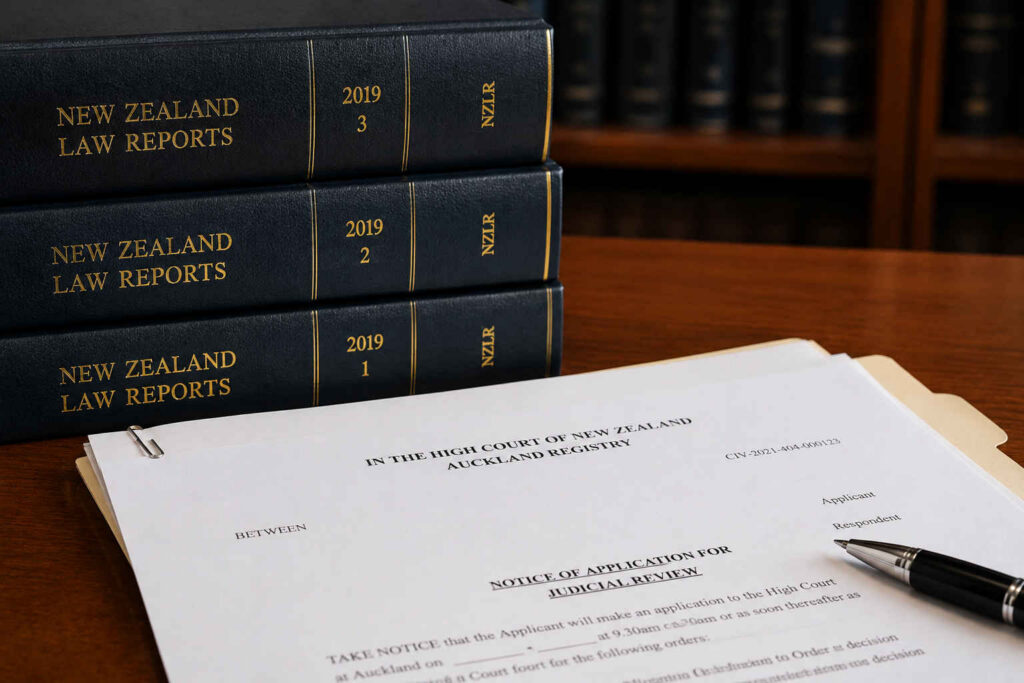
When a government agency, Minister, or statutory decision-maker gets it wrong, most people assume there’s nothing they can do about it.
That’s not quite right. New Zealand’s judicial review jurisdiction gives the High Court the power to scrutinise decisions made by the Executive branch of government — and, where the decision-maker has acted outside their legal powers, to strike it down.
This isn’t about whether the decision was fair in some general sense, or whether a different outcome would have been better. Judicial review is narrower and more technical than that. It’s about whether the decision-maker acted lawfully.
What is judicial review?
Judicial review is the process by which a judge of the High Court examines the actions or decisions of a public body — including central government agencies, Ministers, and Crown entities — to determine whether they acted within the powers the law gave them. If you bring the proceeding, you’re the applicant; the decision-maker is the respondent.
Only a person affected by the decision can apply. And the challenge has to go to either the process used to reach the decision, or an argument that the decision-maker didn’t act within the law, or that the decision itself was unreasonable.
Crucially, judicial review only reaches the exercise of executive power. Parliament’s own legislative decisions aren’t reviewable this way — New Zealand’s constitutional arrangements preserve parliamentary supremacy, so an Act of Parliament itself can’t be challenged in the High Court through judicial review. What can be challenged is how a Minister, department, board, or agency exercised a power that Parliament gave them.
The legal framework
The procedural rules sit in the Judicial Review Procedure Act 2016, which re-enacted (with modernised language, but no change in substance) Part 1 of the old Judicature Amendment Act 1972. The Act applies to the exercise, refusal to exercise, or proposed/purported exercise of a “statutory power” — a term that’s deliberately drawn wide. It covers powers under an Act, or under the constitution, rules, or bylaws of a body corporate, to make decisions affecting a person’s rights, powers, privileges, immunities, duties, or liabilities.
The courts have confirmed that this net is meant to be cast broadly. In principle, all exercises of public power are judicially reviewable, and the phrase “statutory power of decision” is given a liberal interpretation. Even advice given by a government entity to a Minister — not just the Minister’s final decision — can be amenable to review, where that advice is itself a clear exercise of a statutory power.
That said, breadth of jurisdiction doesn’t mean the courts will second-guess policy calls. Where Parliament has entrusted a decision to a particular agency’s expertise and discretion, the courts generally defer to that agency, provided it has gone through the appropriate decision-making steps. The Court’s role is to check that the decision-maker stayed within its statutory lane and acted consistently with the statute’s purpose — not to substitute its own view of the merits.
The grounds for review
Broadly, an applicant needs to show one (or more) of the following:
- Illegality: the decision-maker acted outside the powers given to them by law, misinterpreted their statutory authority, or took into account irrelevant considerations (or failed to consider relevant ones).
- Procedural unfairness: the process leading to the decision was flawed, for example a failure to give someone a fair hearing before a decision affecting their rights was made.
- Unreasonableness: the decision was so unreasonable that no reasonable decision-maker could have reached it, sometimes described in the older cases as a decision “no reasonable authority could ever have come to.”
These grounds aren’t mutually exclusive, and a well-pleaded application will often run more than one in the alternative.
What the court can do about it
If an application succeeds, the High Court has a flexible toolkit under the Act. It can grant declarations, injunctions, or the traditional prerogative-style relief (in substance, the equivalents of mandamus, prohibition, and certiorari), and it can direct the decision-maker to reconsider all or part of the matter. Where a decision is only affected by a defect in form or a technical irregularity, and no substantial wrong or miscarriage of justice has occurred, the Court has discretion to validate the decision anyway rather than set it aside — a useful safeguard against review being used to unpick decisions over trivial slips.
The Court also retains a general discretion to refuse relief even where a ground of review is made out — for example, where the applicant has delayed unreasonably, or where granting relief would cause disproportionate harm to third parties who relied on the decision.
Why this matters in practice
Judicial review comes up more often than people expect — immigration decisions, licensing and accreditation decisions, funding and eligibility decisions, and high-profile policy advice have all been tested through this jurisdiction. A recent example is the review of climate change policy advice given to a Minister, which confirmed that even expert advisory output from a government entity can be reviewable where it forms part of a statutory decision-making process — while also reaffirming that the courts will still show real deference to the substance of technical, policy-laden judgment calls.
For anyone affected by a central government decision — whether it’s a visa refusal, a licensing knockback, a funding decision, or something else — the first question is always whether there’s an arguable public law error, not just an unwelcome outcome. Judicial review isn’t an appeal on the merits. It’s a check on whether the power was exercised lawfully, fairly, and reasonably.
If you think a government decision affecting you may have been made unlawfully, it’s worth getting advice early — judicial review proceedings are subject to strict timeframes, and delay can itself be a reason the Court refuses relief.
This article is general information only and does not constitute legal advice. If you are considering challenging a government decision, contact for advice specific to your circumstances.